TECHNICAL ADVANTAGES
Advanced polymer materials technology use plastic instead of glass to lead a new era of "light and bright" new PV modules
INDUSTRY STATUS AND PAIN POINTS
INSUFFICIENT ROOF LOAD
- ·The application of distributed photovoltaics are mostly on building surfaces. A considerable proportion of existing industrial and commercial factory roofs lack sufficient loading capacity.
- ·If traditional photovoltaic modules are installed on existing roofs, most roofs will need to be reinforced, causing additional renovation costs.
CURVED SURFACES CAN'T BE APPLIED
- ·Many industrial and commercial building roofs adopt curved surface designs for aesthetics, waterproofing, and thermal insulation.
- ·Traditional photovoltaic systems are often heavy and rigid, making it difficult to adapt to different shapes and curves.
High frequency vibration leads to increased glass breakage rate
- ·High-frequency vibration from road traffic and mechanical equipment significantly increases the breakage rate of traditional glass components.
Safety issues of high-altitude installation
- ·Due to their heavy weight, glass modules significantly increase the safety risks of high-altitude installation operations.
25 YEARS OF SHINING IN THE RENEWABLE ENERGY WORLD UNFADINGLY
SAFE AND RELIABLE
SUPER DURABLE
HIGH-EFFICIENCY AND HIGH INCOME
Material technology advantages
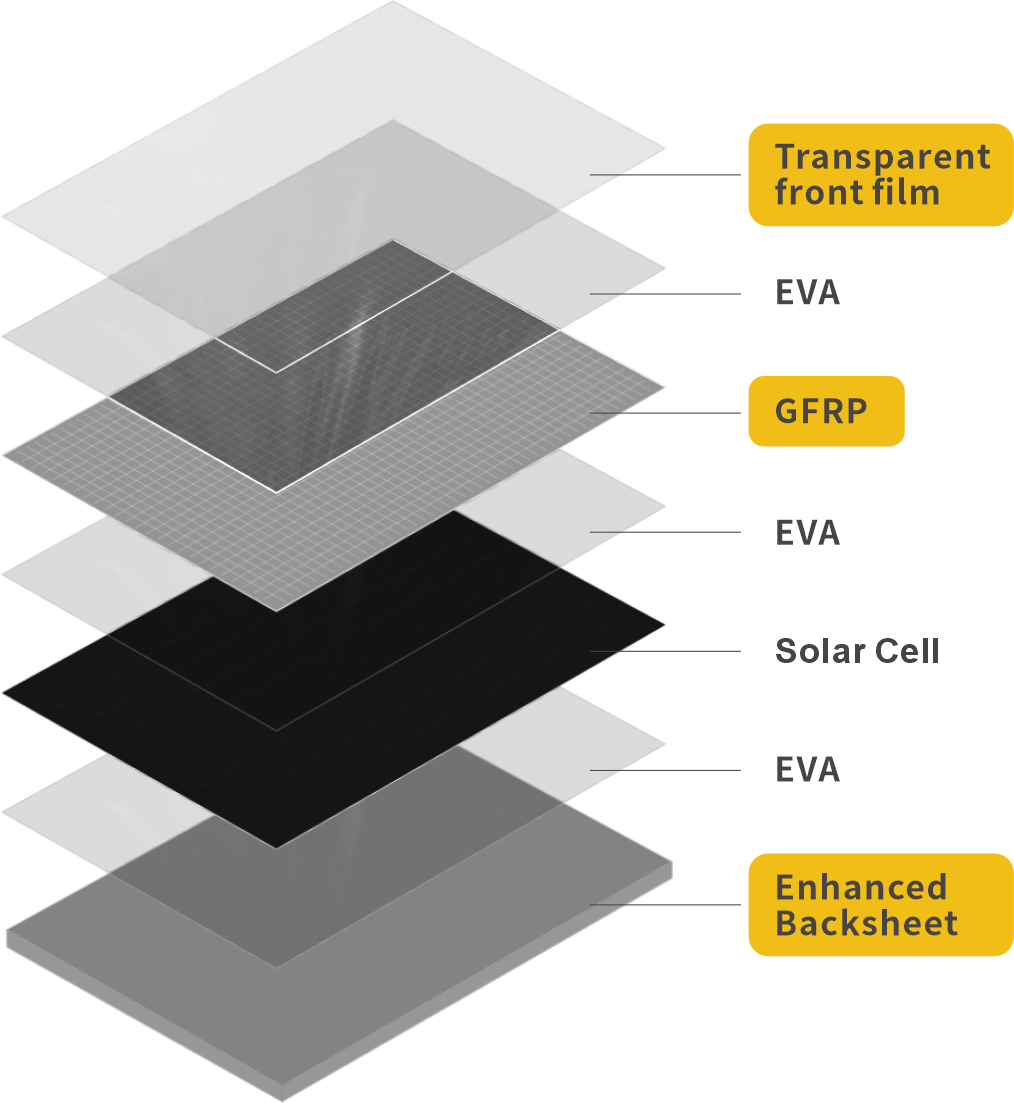
INDEPENDENTLY DEVELOPED TRANSPARENT FRONT FILM, GLASS FIBER REINFORCED COMPOSITE MATERIALS, ENHANCED BACKBOARD
Polymer Chain Group Modification Technology
- ·Light transmittance ≥ 91%
- ·Uninterrupted photoelectric conversion
- ·Ultra-high UV-blocking capacity
- ·Sustained power generation efficiency over 25 years
Data verification: 20 years of field data + 20,000-hour accelerated aging tests with yellowing index Δ≤3
Enhanced Resin-Fiber Interface Technology
- ·Delivers modulus up to 1300MPa, 100% higher than competing products
- ·Enhances overall component strength while minimizing cell micro-crack risks
- ·Improves hail impact resistance
Nano Oxide Coating Self-Cleaning Technology
- ·Dissipates charges and suppresses static electricity, reducing dust accumulation
- ·Delivers 3-5% efficiency gains

Nano hybrid modification and surface fire-resistance treatment
- ·Withstands 30-minute continuous heat gun exposure at ~400°C with backsheet integrity maintained
DISADVANTAGES OF TRADITIONAL MODULES
Traditional modules cannot meet the needs of modern photovoltaic integrated buildings.
- ·Limited Load - heavy weight, high roof load requirements
- ·Safety Risk - risk of self-explosion (3‰)
- ·Additional costs - steel structure/bracket costs, labor costs
- ·Insufficient Shock Resistance - fragile glass module
- ·Aesthetic Shortcomings - single color, poor adaptability
SOLUTION
HIGH-EFFICIENCY AND LIGHTWEIGHT PHOTOVOLTAIC MODULES AND BIPV PRODUCTS
LIGHTER
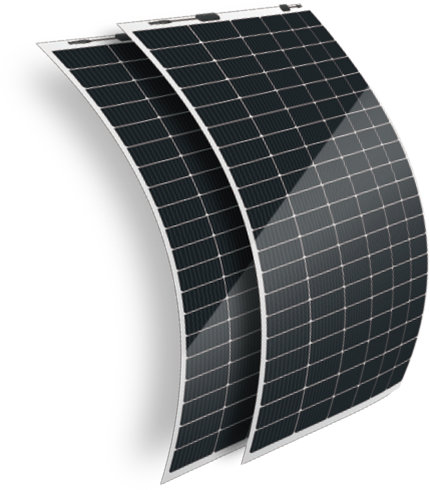
Only 30% of the weight of traditional modules
MORE FLEXIBLE
Better integration into architectural design
SHINING GREEN ENERGY WORLD
Higher and more stable power generation efficiency
Lightweight
Ultra-lightweight design that reduces structural load and facilitates easy installation.
Our lightweight flexible photovoltaic panels weigh only 2-3 kg/m², compared to 15-20 kg/m² for traditional panels. This dramatic weight reduction enables installation on roofs that cannot support conventional solar systems, opening new possibilities for industrial buildings, warehouses, and structures with limited load-bearing capacity.
Key Features
- Weight only 2-3 kg/m²
- Ideal for roofs with limited load-bearing capacity
- Easy transportation and handling
- Reduced installation costs
- Suitable for building renovations
Flexible
High flexibility allowing application on curved surfaces and various shapes.
The unique flexibility of our panels allows adaptation to curved surfaces with a bending radius of up to 30 degrees. This makes them ideal for applications on curved roofs, vehicles, boats, and architectural structures with non-flat surfaces.
Key Features
- Bending radius up to 30 degrees
- Adaptation to curved surfaces
- Ideal for vehicles and boats
- Architectural integration
- Flexible placement
High Transparency
Excellent optical transparency for aesthetically appealing installations.
Our transparent photovoltaic panels offer optical transmittance up to 40%, allowing natural light to pass through while generating electricity. This makes them ideal for greenhouses, canopies, curtain walls, and architectural applications where aesthetics and natural lighting are important.
Key Features
- Optical transmittance up to 40%
- Ideal for greenhouses
- Suitable for curtain walls
- Aesthetically appealing
- Natural interior lighting
Super Weather Resistance
Resistance to extreme weather conditions, UV radiation, and temperature variations.
Our panels are designed to withstand the most extreme weather conditions. With certification for temperatures from -40°C to +85°C, resistance to hail and strong winds, as well as UV protection, we guarantee reliable performance for over 25 years.
Key Features
- Operation from -40°C to +85°C
- Hail resistance
- Strong wind resistance
- UV protection
- 25+ year warranty
High Modulus
High elastic modulus for optimal structural integrity and performance.
The high elastic modulus of our materials ensures excellent structural stability and resistance to mechanical stress. This means the panels maintain their shape and performance even under intense mechanical loading conditions.
Key Features
- Excellent structural stability
- Resistance to mechanical stress
- Shape retention
- Long-term performance
- Reliable operation
Good Water Resistance
Excellent waterproofing and moisture protection for long-term reliability.
Our panels feature advanced sealing technology with IP67 protection rating. This ensures complete protection against water and moisture ingress, making them ideal for outdoor installations in any climate zone.
Key Features
- IP67 protection rating
- Complete waterproofing
- Moisture protection
- Suitable for any climate
- Long-term reliability